Videos
(Admin and Supervisor Roles can access)
This contains a list of all the videos that have been uploaded to the server. Clicking on a video will expand it to show which users have access to the video. By default, users only have access to videos that they upload.
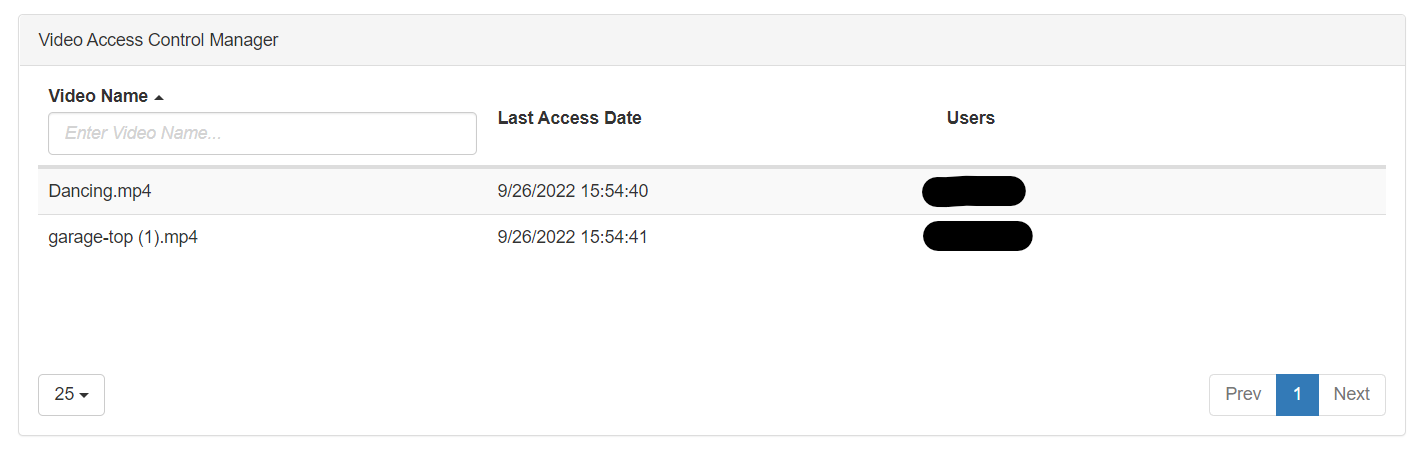
To grant users access to a video that they didn’t upload:
- Click on the desired video’s row.
- Click the “Add User” button to open up the list of all Redactor users.
- Check the boxes to the left of any users you want to see the video.
- Click the “Save Changes” button.
- The users will now see the video on their Recent Videos the next time they open it.
To remove a user’s access to a video:
- Click on the desired video’s row.
- Click the “Remove” button to remove the user from the video instantly.
Work Time
When work-time tracking is enabled, each video in the list shows the total time editors have spent on it, formatted as HH:MM:SS. The value appears only once it is greater than zero.
Administrators and supervisors can clear this value by right-clicking a video (or a bulk selection) and choosing Reset Work Time. This item appears only for videos whose recorded work time is not already zero; in a bulk selection it applies to every selected video that has non-zero work time. Because the value cannot be recovered afterwards, a confirmation prompt is shown first, and each reset is recorded in the session’s audit log.
Acquire Audit Data
For one or more videos that are not currently open, right-click and choose Acquire Audit Data to download a ZIP archive of audit information. For each session the archive contains a CSV audit log ({session-id}_audit.csv) whose rows document which user did what, and when — ready to open in a spreadsheet application.
Every archive also includes a top-level info.json file describing the archive and its contents:
- Origin — the host that produced the archive: its hostname, network (MAC) addresses, and the operating-system user.
- Archive details — a format version and the time the archive was created.
- Per-session entries — for each session: its identifier, the file name and SHA-256 checksum of that session’s audit CSV (so you can confirm the log has not been altered), and the video’s metadata.